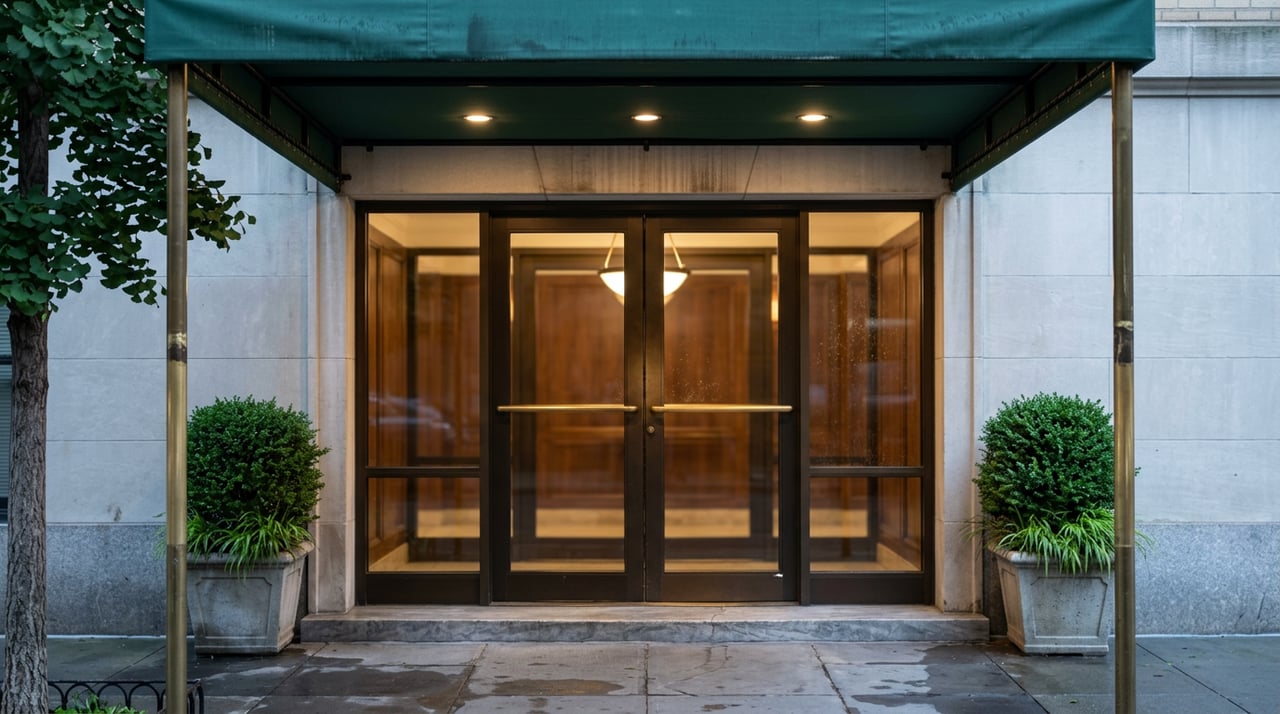
New York's New Co-op Deadline Law Has an Upper West Side Loophole Built In
August 13, 2026
August 13, 2026
Terry Meehan and his family spent months compiling a board package for a co-op on the Upper West Side, a package that grew to nearly five inches of paper before anyone scheduled an interview. He described the process to NY1 the week New York's new co-op application law finally took effect.
"They knew everything we did for the last seven years, they had pictures of our dog, they had references for the dog, everything."
That process is now governed by a statute. The Cooperative Application Timeline Law, formally Local Law 2026/058, requires co-op boards across the city to acknowledge a purchase application within 15 days and issue a decision within 45. It took effect July 28, 2026, less than two weeks before this was written, and it applies to every purchase application submitted on or after that date.
For anyone listing or buying an Upper West Side co-op this fall, the headline sounds like relief: a hard deadline where none existed before. Read past the headline and a different picture appears. The same law that imposes the 45-day clock also lets a board stop that clock entirely for the two months when most fall listings hit the market.
Once a board receives a purchase application, it has 15 days to send written acknowledgment, by both email and registered mail, confirming the package is complete or listing exactly what is missing. Miss that window and the application is automatically deemed complete, which starts the 45-day decision clock whether the board meant to start it or not.
From there, the board has 45 days to approve, conditionally approve, or deny. It can take one 14-day extension on its own authority. Anything beyond that requires the applicant's written consent. Boards and management companies that blow through the deadline face fines starting at $1,000 for a first violation, rising to $1,500 and then $2,000, enforced by the city's Department of Housing Preservation and Development. Managing agents carry that liability directly, alongside the volunteer board members who actually sign off on applications.
| Step | Deadline | If missed |
|---|---|---|
| Acknowledge receipt | 15 days | Application automatically deemed complete |
| Decide: approve, conditional, or deny | 45 days from complete | HPD fine, $1,000 for a first offense |
| Board's own extension | 14 days, one time only | Requires written notice before the 45 days run out |
| Further extension | No cap | Requires the purchaser's written consent |
The law stops short of requiring a board to explain a denial. It does not touch subletting, refinancing, or any transfer that isn't a sale, gift, assignment, or devise. And it only reaches cooperatives with more than 10 residential units, which excludes HDFC buildings and Mitchell-Lama developments outright.
Here is the part that matters if you are listing or applying on the Upper West Side this fall. The same law permits a board to adopt a written summer recess policy that tolls both the 15-day and 45-day clocks during July and August, provided the board put that policy in writing before the law took effect on July 28.
A board that filed a recess policy in June can legally freeze the clock the moment it starts. An application submitted on August 10 to a building with a standing recess policy may not see day one of its 45-day window until September 1. The statute built to end open-ended waiting still permits two full months of it, as long as the paperwork authorizing the pause predates the deadline itself.
This is not a hypothetical for the neighborhood. Many prewar boards on the Upper West Side already slow down over the summer, which is precisely the practice this provision was written to accommodate. A seller who lists in August expecting the new 45-day rule to protect a fall closing needs to know, before signing a contract, whether the buyer's target building has adopted that recess policy in writing.
Co-ops dominate the prewar housing stock on the blocks between Central Park West and Riverside Drive, and the boards governing those buildings have a reputation for conservative financial screening that predates this law by decades. That reputation shows up in the numbers buyers are asked to produce. Boards here routinely expect 12 to 24 months of post-closing liquidity, meaning cash and marketable securities left over after the down payment and closing costs, sized to cover mortgage and maintenance for the full window. A building charging $1,500 a month in maintenance with no mortgage on the unit can still expect a buyer to hold somewhere between $18,000 and $36,000 in reserve after the wire clears, and that figure climbs fast in buildings with higher carrying costs or all-cash requirements.
None of that changes under the new law. The 45-day clock only starts once a package is deemed complete, and completeness is still defined by the building's own checklist: two years of tax returns, bank and investment statements, an employer letter, references, and a liquidity showing that matches what that specific board expects. A buyer who submits a package light on reserves does not get a faster no. They get a request for more documents, which resets the 15-day acknowledgment clock and pushes the eventual 45 days further out on the calendar.
Flip tax customs add a second layer that has nothing to do with speed but everything to do with what a seller nets once approval comes through. Most Upper West Side co-ops charge a transfer fee when shares change hands, commonly a percentage of the sale price, and it is customary in many buildings for the seller to pay it. That fee comes from the proprietary lease or bylaws, not from this new law, and a seller who hasn't confirmed the exact formula with the managing agent before listing can be caught off guard by the number on the closing statement even when board approval sails through inside 45 days.
A few questions, asked early, do more to protect a fall closing than anything written into the statute itself:
Does this law apply to condo boards too? No. The Cooperative Application Timeline Law applies only to cooperative corporations, not condominiums, which generally hold a more limited right of first refusal rather than full approval power.
Does the 45-day clock cover subletting or refinancing requests? No. As written, the law covers sales, transfers, assignments, gifts, and devises. Sublet applications and refinance approvals fall outside it.
If my application is denied, will the board have to tell me why? Not under this law. Boards can still deny without stating a reason. A separate proposal before the City Council, the Fair Residential Cooperative Disclosure Law, would require written reasons within five days of a denial, but it has not been enacted.
Prewar boards, liquidity thresholds, flip tax formulas, and now a statute with a built-in summer exception. None of it is designed to be intuitive from the outside, which is exactly the terrain where a legally trained eye on your side of the table earns its keep. If you are weighing a fall listing or preparing a board package on the Upper West Side, Fainna Kagan will walk through the specific building's timeline, liquidity expectations, and flip tax formula before you sign anything. Schedule a private consultation.
Stay up to date on the latest real estate trends.




Known for her commitment and responsiveness to her clients, Fainna Kagan has repeatedly set records on the highest selling priced properties. Connect with her today!