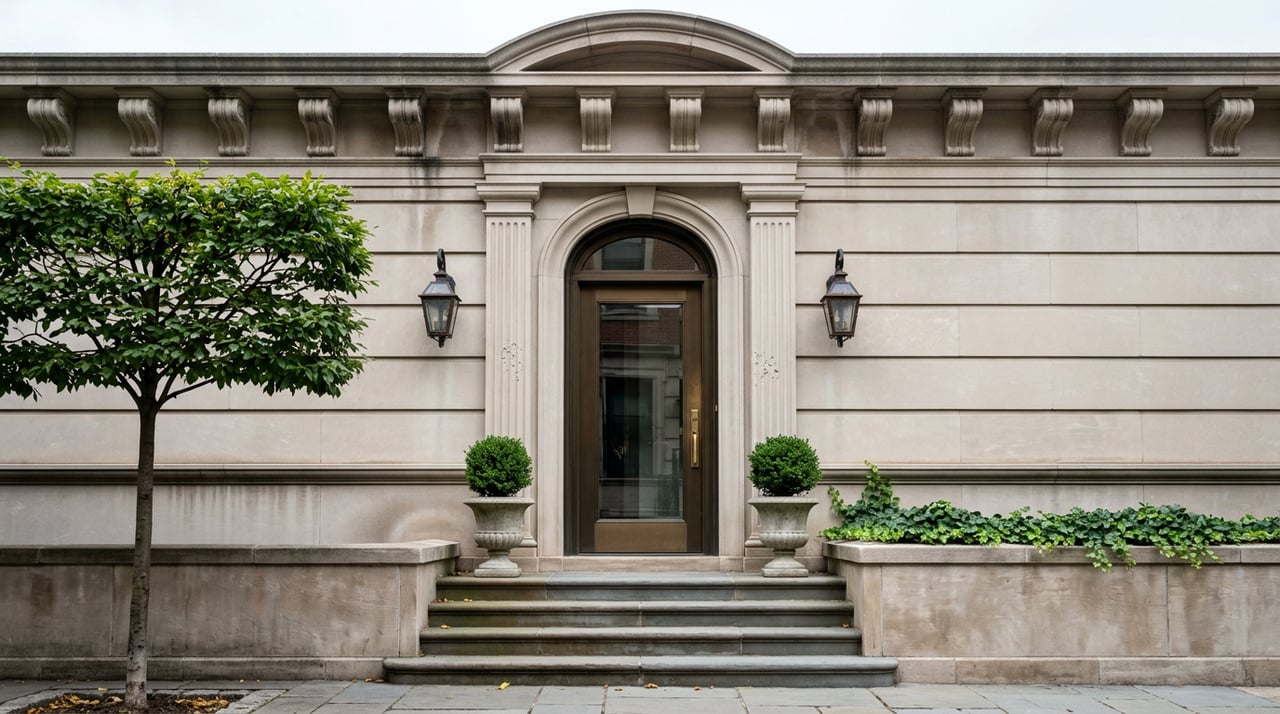
Why the Upper West Side's Co-op Discount Isn't Actually a Discount
September 3, 2026
September 3, 2026
The interview room does not have your broker in it. It does not have your attorney either. By the time you sit down across from a co-op board on the Upper West Side, the negotiating is over and the only person answering questions is you, holding a stack of tax returns and bank statements that a group of your future neighbors has already read twice. Board interviews on Manhattan buildings are almost universally applicant-only. The decision comes back later, through the managing agent to your attorney, and if the answer is no, it usually arrives without a reason attached.
That structure is the reason the price gap between Upper West Side co-ops and condos is more interesting than it looks. As of April 2026, PropertyShark put the neighborhood's median condo sale at roughly $2.4 million against a median co-op sale of roughly $1.4 million, a spread of a full million dollars on paper. It is tempting to read that gap as a straightforward discount for tolerating a board. It is not. Buyers who assume the co-op is simply the cheaper option are usually the ones surprised when the board asks for proof of money they didn't think they needed.
A condo purchase and a co-op purchase are not the same transaction with a different sticker. Corcoran's Manhattan report for March 2026 found signed contracts closing at an average of 2.8 percent below last asking price across both product types, but the two moved differently: condos settled 3.7 percent below ask while co-ops settled only 1.2 percent below ask. Co-op sellers are giving up less ground at the negotiating table, not more. If the product were simply discounted for inconvenience, you would expect the opposite.
What the co-op price actually reflects is a shift in when you have to prove your money exists, not whether you have less of it. A condo board typically holds only a right of first refusal, a formality that rarely blocks a qualified buyer. A co-op board has full discretion to say no, and it exercises that discretion by demanding a specific kind of financial performance that has nothing to do with your mortgage.
| Typical Condo | Typical UWS Co-op | |
|---|---|---|
| Minimum down payment | Around 10 percent | 20 percent baseline, 25 to 50 percent or all-cash at strong prewar buildings |
| Post-closing liquidity | Set by lender | Often 1 to 2 years of mortgage plus maintenance in reserve, set by the board |
| Board review | Right of first refusal | Full discretion, no reason required |
| Time from contract to close | Roughly 1 to 3 months | Roughly 3 to 4 months |
That extra liquidity requirement is the real price of the "discount." A buyer who qualifies for a mortgage on a $1.4 million co-op may still need several hundred thousand dollars sitting untouched in an account after closing, money the bank never asked about and the sale price never reflected. The cash didn't disappear when the price came down. It moved into a column the board controls.
Boards typically want to see a debt-to-income ratio in the neighborhood of 25 to 28 percent, meaning your total housing costs, mortgage, maintenance, and other debt, stay under roughly a quarter of your gross monthly income. That threshold exists independently of what a lender will approve you for, and it is common for a buyer with a clean mortgage approval to fall outside a board's comfort zone anyway.
Post-closing liquidity compounds the effect. A one-to-two-year cushion of mortgage and maintenance payments, held in cash or liquid securities after the deal closes, is a common ask at Upper West Side buildings with strong balance sheets. That is not a nice-to-have. It is frequently the line item that separates an approved application from a rejected one, and unlike the purchase price, it rarely shows up in a listing description.
Rejection itself is not rare, but it is uneven. Across the market, roughly 3 to 5 percent of co-op applications get turned down. At the tier of building that anchors Central Park West, prewar towers with long histories and deep reserves, that figure has been reported as high as 10 to 20 percent. The Dakota, the San Remo, and the Beresford carry reputations for board scrutiny that predate most current owners, and they set the ceiling other buildings are measured against. Most Upper West Side boards run considerably warmer in tone than that ceiling suggests, but the paperwork standard barely softens. A friendlier interview does not mean a lighter file.
A board approval doesn't test whether you can afford the apartment. It tests whether you can afford it without ever touching the building's own math.
Buyers who assume their mortgage approval is the hard part are often blindsided by failures that have nothing to do with income. The patterns that recur most often on Upper West Side applications:
None of these require bad credit or low income. They require a package that reads clearly to people who have no obligation to ask a follow-up question before voting no.
The same building-specific logic that governs board approval also governs what you keep when you eventually sell. Most Upper West Side co-ops charge a flip tax, a transfer fee paid to the building rather than the government, typically running 1 to 3 percent of the sale price. On many Upper West Side buildings it is customary for the seller to pay it, though the exact structure, whether it is a flat percentage, a per-share amount, or a tiered formula, is written into that specific building's proprietary lease and bylaws. There is no citywide standard. A buyer who skips confirming the formula in writing before closing is signing up for a future seller-side surprise, and a seller who lists without checking is setting a net-proceeds expectation that the building can quietly override.
The board approval process is not static, and two 2026 developments are worth knowing before you submit a package.
A City Council bill that would require co-op boards in buildings with at least 10 units to disclose their reasons for rejecting a buyer has picked up 29 sponsors but remains stalled. Council Member Gale Brewer, whose district covers close to 28,000 co-op units on the Upper West Side, has declined to take a position, citing concern that potential fines of up to $25,000 would discourage residents from serving on boards at all. Until or unless that changes, a rejected Upper West Side buyer should still expect silence rather than an explanation, which is exactly why a clean, well-organized package matters more here than almost anywhere else in the country.
Separately, Local Law 58 now requires co-op boards to acknowledge receipt of an application in writing within 15 days, specifying whether it is complete, with acknowledgment sent by both email and registered mail. Buildings including 285 Central Park West have already built the associated administrative fee into their application process. It is a small procedural shift, but it means the clock on your application is now something you can point to in writing rather than take on faith.
The headline price gap between an Upper West Side co-op and a comparable condo is real, but it is not free money. It is a trade of purchase price for proof, and the proof requirement doesn't show up until you're deep into a deal you already want. Buyers who go in understanding the liquidity math, the documentation standard, and the specific building's own norms are the ones who clear a board on the first pass instead of the second.
That is the part of the process where an attorney's eye for detail and a broker's familiarity with a specific building's culture matter more than the listing price ever will. Fainna Kagan has spent years preparing Upper West Side buyers for exactly this moment, building the financial narrative a board wants to see before the file ever reaches the interview room. If you are shopping co-ops on the Upper West Side and want a clear-eyed read on what a specific building will actually require, schedule a private consultation before you make an offer, not after a rejection letter you'll never fully understand.
Does a mortgage pre-approval mean I'll pass the board? No. Lenders evaluate your ability to repay a loan. Boards evaluate whether your full financial picture, including post-closing liquidity and debt-to-income ratio, matches what that specific building expects, and those standards are frequently stricter than a bank's.
Can a board reject me without telling me why? Yes, under current law, as long as the rejection is not based on a legally protected characteristic under fair housing law. A pending City Council bill would change that for buildings with 10 or more units, but it has not passed.
How long does the process take on the Upper West Side? Financed co-op purchases typically run three to four months from signed contract to closing, longer than a comparable condo purchase, largely because of the board review and interview scheduling built into the timeline.
Stay up to date on the latest real estate trends.
Known for her commitment and responsiveness to her clients, Fainna Kagan has repeatedly set records on the highest selling priced properties. Connect with her today!